

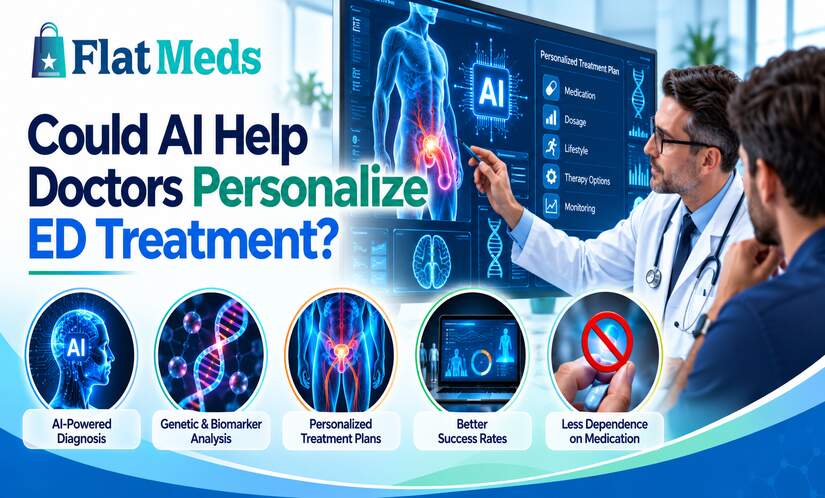
Imagine if your doctor could understand why a particular erectile dysfunction (ED) treatment works for one person but not another—and use that information to develop a more personalized treatment plan. Artificial intelligence (AI) is bringing this possibility closer to reality by helping healthcare professionals analyze patient data, identify health patterns, and make more informed clinical decisions.
Could AI help doctors personalize ED treatment? Yes, AI has the potential to support more individualized erectile dysfunction care by analyzing medical history, lifestyle factors, underlying health conditions, and treatment responses. However, AI is not a replacement for qualified medical professionals, and its effectiveness in ED care depends on clinical validation and responsible use.
As personalized medicine evolves, AI could become a valuable tool in men’s sexual health, helping doctors move toward more data-informed and patient-centered treatment decisions.
What Is Erectile Dysfunction, and Why Does Treatment Need Personalization?
Erectile dysfunction is the persistent inability to achieve or maintain an erection sufficient for satisfactory sexual activity. It can be associated with cardiovascular disease, diabetes, hormonal imbalances, neurological conditions, psychological stress, medication side effects, and lifestyle factors.
Because Erectile Dysfunction can have several contributing causes, the same treatment may not work equally well for every patient.
| Factor | How it may affect ED | Role of personalized care |
|---|---|---|
| Cardiovascular health | Blood flow problems may contribute to ED | Assess cardiovascular risks |
| Diabetes | Nerve and blood vessel damage may affect erections | Address diabetes management |
| Hormonal health | Low testosterone may contribute in selected cases | Evaluate symptoms and hormone levels when indicated |
| Psychological factors | Anxiety, stress, and depression may affect sexual function | Consider psychological support |
| Medications and lifestyle | Certain drugs, smoking, and inactivity may contribute | Review medications and lifestyle habits |
Personalized erectile dysfunction treatment considers these differences rather than relying on a one-size-fits-all approach.
How Can AI Help Doctors Personalize ED Treatment?
AI uses computational methods, including machine learning and predictive analytics, to identify patterns in large datasets. In healthcare, these capabilities may help clinicians interpret complex information and support individualized treatment decisions.
1. Analyzing Patient Health Data
AI systems can potentially analyze electronic health records, medical histories, laboratory results, and relevant lifestyle information to identify patterns associated with erectile dysfunction.
For example, a clinical decision-support system might flag that a patient has diabetes, cardiovascular risk factors, and medications that warrant further review. The doctor can then investigate these factors during the clinical assessment.
AI does not independently establish the cause of Erectile Dysfunction simply by detecting patterns. Its findings must be interpreted alongside symptoms, examination results, and professional medical judgment.
2. Predicting Treatment Response
Different patients can respond differently to erectile dysfunction medications and other treatment options. AI may eventually help researchers and clinicians identify characteristics associated with treatment response.
| Treatment approach | Potential role of AI | Important limitation |
|---|---|---|
| Oral ED medications | Support analysis of response patterns | Cannot guarantee an individual outcome |
| Lifestyle changes | Help monitor relevant health trends | Requires reliable patient data |
| Hormonal evaluation | Identify cases that may need further assessment | Cannot replace appropriate testing |
| Psychological support | Help identify relevant reported symptoms | Sensitive decisions require clinical oversight |
Treatments such as sildenafil and tadalafil are established options for many patients when medically appropriate. AI may help support clinical decision-making, but it should not independently prescribe medication or determine dosage.
3. Identifying Underlying Health Conditions
Erectile dysfunction can sometimes be an early indicator of broader health concerns, including cardiovascular disease or diabetes.
AI-assisted healthcare tools may help flag combinations of risk factors that deserve further investigation. For instance, a system could identify a pattern of diabetes, hypertension, and reported erectile difficulties in a patient’s records.
Such alerts could encourage timely assessment. However, AI cannot confirm an underlying condition without the appropriate clinical evaluation and diagnostic testing.
4. Supporting Ongoing Treatment Monitoring
Personalized ED treatment often involves follow-up appointments and adjustments based on effectiveness, side effects, and patient preferences.
Digital health platforms may help patients report symptoms, document treatment responses, and communicate relevant changes to their clinicians. AI could summarize these reports and identify trends that deserve attention.
This approach may make follow-up care more structured, although patient-reported information must be interpreted carefully and handled confidentially.
What Are the Benefits of AI in Personalized ED Treatment?
AI-assisted clinical decision-making could offer several potential benefits when properly developed and validated.
- More individualized care: Helps clinicians consider multiple patient-specific factors.
- Better-informed decisions: Organizes complex medical information into useful summaries.
- Earlier risk identification: May flag patterns associated with underlying health conditions.
- Improved follow-up: Supports monitoring of symptoms and treatment responses.
- More efficient workflows: May reduce the time clinicians spend reviewing large amounts of structured information.
These benefits are potential advantages rather than guaranteed outcomes. Their actual impact depends on the quality of the AI system, the evidence supporting its use, and how clinicians integrate it into care.
What Are the Risks and Limitations of AI in Erectile Dysfunction Treatment?
Despite its promise, AI in erectile dysfunction treatment faces important challenges.
Data privacy: Medical records contain sensitive sexual and reproductive health information. AI systems must protect patient confidentiality and use appropriate security safeguards.
Algorithmic bias: If training data underrepresent certain age groups, populations, or health conditions, an AI system may produce less reliable recommendations for those patients.
Limited clinical evidence: A model that performs well in a research setting may not necessarily improve real-world treatment outcomes. Clinical validation is essential before relying on AI recommendations.
Incorrect predictions: AI can generate misleading results when data are incomplete, inaccurate, or outside the model’s intended use.
Human oversight: Decisions about diagnosis, medication safety, and treatment selection require qualified clinicians who understand the patient’s circumstances.
AI should therefore complement established medical care rather than replace professional evaluation.
Can AI Replace Doctors in Erectile Dysfunction Treatment?
No. AI cannot replace doctors in diagnosing and managing erectile dysfunction. It can potentially assist with data analysis, risk assessment, and treatment monitoring, but clinicians remain responsible for evaluating symptoms, identifying possible causes, reviewing contraindications, and discussing suitable options with patients.
For example, erectile dysfunction medications may be unsafe for some people who use nitrate medications because the combination can cause a dangerous drop in blood pressure. A qualified clinician must review medication interactions and relevant medical conditions before recommending treatment.
Patients experiencing persistent Erectile Dysfunction should seek medical advice instead of relying solely on AI chatbots or online treatment recommendations.
The Future of AI in Personalized Men’s Sexual Health
The future of AI in erectile dysfunction treatment may involve better clinical decision-support systems, more integrated digital health platforms, and predictive models that have been tested in diverse patient populations.
Researchers may explore whether combining medical history, laboratory findings, patient-reported symptoms, and treatment outcomes can improve individualized care. However, these applications need robust evidence demonstrating that they are safe, accurate, and beneficial in clinical practice.
For healthcare professionals, the priority should be using AI tools that are transparent, clinically validated, privacy-conscious, and designed to support, not override, medical judgment.
Frequently Asked Questions (FAQs)
1. Could AI help doctors personalize ED treatment?
Yes, AI may help doctors analyze patient-specific information and support more individualized treatment decisions.
2. How does AI work in erectile dysfunction treatment?
AI can analyze medical records, risk factors, and treatment-response data to identify patterns that may assist clinicians.
3. Can AI diagnose erectile dysfunction?
AI may support clinical assessment, but a qualified healthcare professional must establish the diagnosis.
4. Can AI predict which ED medication will work best?
AI may help researchers identify treatment-response patterns, but it cannot reliably guarantee which medication will work for an individual.
5. Is AI-based erectile dysfunction treatment safe?
Its safety depends on the tool’s validation, intended use, data protection, and appropriate medical supervision.
6. Can AI replace doctors in ED treatment?
No, AI should support rather than replace doctors in diagnosis, treatment selection, and medication safety assessment.
7. What role does machine learning play in ED care?
Machine learning can identify patterns in health data that may help clinicians understand risk factors and treatment outcomes.
8. Can AI identify the underlying causes of Erectile Dysfunction?
AI may flag relevant patterns, but confirming underlying causes requires appropriate medical evaluation and testing.
9. Will AI make erectile dysfunction treatment more personalized?
Potentially, yes, if AI tools demonstrate reliable performance and improve clinical decision-making in real-world settings.
10. What is the future of AI in men’s sexual health?
Future applications may include validated clinical decision support, personalized risk assessment, and improved digital treatment monitoring.
Conclusion
Could AI help doctors personalize Erectile Dysfunction treatment? AI has meaningful potential to support personalized erectile dysfunction care by analyzing patient data, identifying risk patterns, and helping clinicians monitor treatment responses.
Nevertheless, AI-assisted Erectile Dysfunction treatment remains an evolving area. Its value depends on scientific evidence, patient privacy, clinical validation, and professional oversight. The most promising approach is not replacing doctors with algorithms, but combining responsible AI technology with medical expertise to deliver safer, more individualized men’s healthcare.