

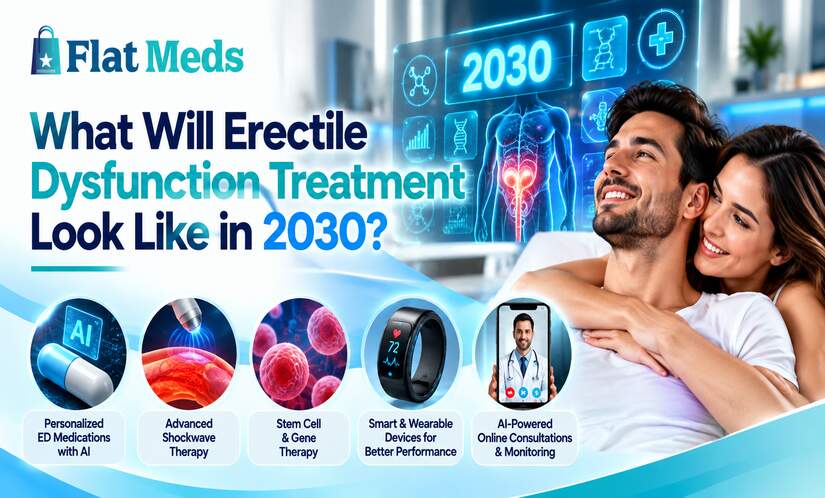
Imagine visiting a doctor in 2030 and receiving an erectile dysfunction treatment plan designed around your individual health, medical history, lifestyle, and response to previous therapies—not simply a prescription based on your symptoms.
Your doctor might use more sophisticated diagnostic tools, digital health information, and personalized treatment strategies to help identify why you are experiencing erectile dysfunction. Researchers may also have clearer answers about which emerging therapies work, who benefits from them, and which treatments should be avoided.
Sounds promising, doesn’t it?
Erectile dysfunction (ED) affects millions of men worldwide and can influence far more than sexual performance. It may affect confidence, relationships, emotional well-being, and overall quality of life. For some men, it is also an early warning sign of underlying conditions such as diabetes, high blood pressure, or cardiovascular disease.
Today, established treatments including sildenafil, tadalafil, vacuum erection devices, injections, and penile implants help many men manage the condition. However, treatment does not work equally well for everyone, and some patients continue to experience unsatisfactory results or unwanted side effects.
That is why the future of erectile dysfunction treatment is attracting attention.
By 2030, advances in personalized medicine, artificial intelligence (AI), digital healthcare, and clinical research may improve how Erectile Dysfunction is diagnosed and managed. Emerging approaches such as low-intensity shockwave therapy and regenerative medicine are also being investigated, although their effectiveness and long-term benefits remain uncertain.
The important question is not whether Erectile Dysfunction will definitely have a cure by 2030, but how medical science might make treatment more individualized, effective, and accessible.
Let’s explore the technologies, treatments, and research directions that could shape the future of erectile dysfunction care.
1. Why Is Erectile Dysfunction Treatment Evolving?
Erectile dysfunction occurs when a person consistently has difficulty achieving or maintaining an erection sufficient for satisfactory sexual activity.
It is not a single disease with one universal cause. ED may be associated with vascular problems, diabetes, hormonal disorders, neurological conditions, medication effects, psychological stress, or a combination of factors.
This complexity explains why treatment approaches are evolving.
For example, a man whose ED is associated with impaired blood flow may need a different approach from someone whose symptoms are primarily related to anxiety, medication side effects, or a hormonal condition.
Traditionally, many patients have started with oral medications. These remain important treatments, but advances in diagnosis and research may help clinicians make more informed decisions about which treatment is most appropriate for each patient.
Three developments are particularly relevant:
- Better identification of underlying causes: More comprehensive assessment may help distinguish vascular, hormonal, neurological, medication-related, and psychological contributors.
- More individualized treatment selection: Clinicians may increasingly consider a patient’s medical profile, preferences, response to previous treatments, and risk factors.
- Stronger evidence for emerging therapies: Continued clinical trials may clarify which newer approaches offer meaningful benefits and which remain experimental.
The future of ED treatment will likely involve improving existing care as much as introducing new technology.
2. Personalized Medicine Could Transform ED Treatment by 2030
One of the most promising directions in modern healthcare is personalized medicine.
Instead of using the same treatment pathway for everyone, personalized care considers the individual characteristics that influence disease and treatment response.
In erectile dysfunction, this could mean assessing cardiovascular health, blood sugar levels, medication use, hormonal symptoms, mental health, and previous treatment outcomes before selecting a management plan.
For example, a patient with diabetes and vascular risk factors may benefit from a combination of ED treatment and careful management of blood glucose, blood pressure, cholesterol, and lifestyle habits.
Another patient may need medication review, psychological support, or evaluation for a hormonal disorder.
How Personalized ED Treatment May Work
By 2030, clinicians may have better tools for combining information from medical history, laboratory testing, validated questionnaires, and digital health records.
This information could help guide treatment decisions, although individual treatment responses will still vary.
| Current approach | Potential future direction | Important limitation |
|---|---|---|
| Symptom-based assessment | More comprehensive individual risk assessment | No single test explains every case |
| Trial-and-error treatment | More informed treatment selection | Response still varies between patients |
| Periodic follow-up | Better-supported digital monitoring | Privacy and data quality matter |
| General lifestyle advice | More tailored health recommendations | Clinical oversight remains important |
Personalized medicine does not mean that every patient will need genetic testing or expensive technology. Often, the most useful improvement may be a more complete assessment and better communication between the patient and clinician.
The goal is to identify the most appropriate treatment for the individual rather than searching for one option that works for everyone.
3. Could Artificial Intelligence Improve ED Diagnosis and Treatment?
Artificial intelligence is becoming increasingly relevant in healthcare, from medical image analysis to clinical decision support.
By 2030, AI may have a greater role in helping healthcare professionals organize medical information, identify patterns, and support decisions about erectile dysfunction.
For example, appropriately validated systems might help clinicians review symptoms, medical history, medication lists, and cardiovascular risk factors. Digital tools could also make follow-up assessments more convenient.
However, these are potential applications, not a guarantee that AI will independently diagnose ED or prescribe treatment safely.
Potential Applications of AI in Men’s Sexual Health
- Risk assessment: AI-assisted systems could help identify patients who need evaluation for diabetes, cardiovascular disease, or other contributing conditions.
- Treatment monitoring: Digital questionnaires may help track changes in erectile function and patient satisfaction over time.
- Clinical decision support: Validated tools could assist clinicians in comparing treatment options and identifying medication interactions or contraindications.
- Patient education: Conversational health tools may make reliable information about ED, medications, and medical consultations easier to access.
Despite these possibilities, AI has important limitations. Incomplete information, biased training data, inaccurate outputs, and privacy concerns can affect its usefulness.
An AI system should not replace a qualified healthcare professional, particularly when symptoms may indicate a broader health problem.
The likely opportunity is better-supported clinical decision-making—not a future in which algorithms automatically solve every case of erectile dysfunction.
4. Will ED Medications Become More Advanced by 2030?
Oral medications are likely to remain an important part of erectile dysfunction treatment.
PDE5 inhibitors, including sildenafil (Viagra) and tadalafil (Cialis), are established options that help improve the erectile response during sexual stimulation.
These medications work by supporting the physiological pathways that relax smooth muscle and increase blood flow in penile tissue. They do not automatically create sexual desire or produce an erection without the relevant physiological stimulation.
Future research may explore improved formulations, delivery methods, tolerability, and ways to identify which patients are most likely to benefit from particular medications.
However, it is not possible to predict which investigational drugs will become available by 2030 or whether they will be more effective than current options.
What Could Improve in Future ED Medications?
Researchers may continue to investigate:
- Alternative drug-delivery methods.
- Ways to improve convenience and adherence.
- Better management of treatment-related adverse effects.
- New approaches for patients who do not respond adequately to existing therapies.
- Treatment strategies that address specific underlying causes.
Any new medication must demonstrate an acceptable balance of safety and effectiveness through appropriate clinical evaluation and regulatory review.
Patients should not assume that a newer medication will automatically be safer or more effective than an established treatment.
It is also important to remember that PDE5 inhibitors are not suitable for everyone. For example, combining these medicines with nitrate medications can cause a dangerous drop in blood pressure.
By 2030, the most meaningful progress may involve helping patients use established medications more appropriately, alongside the development of genuinely useful new options.
5. What Is the Future of Shockwave Therapy for ED?
Low-intensity extracorporeal shockwave therapy (Li-ESWT) is one of the emerging approaches attracting attention in erectile dysfunction research.
The treatment uses low-intensity acoustic shockwaves delivered to targeted areas of penile tissue. Researchers are investigating whether these waves may stimulate biological responses associated with vascular function and tissue repair.
Because blood flow plays a central role in erections, the treatment has received particular interest in the context of vasculogenic ED.
Could Shockwave Therapy Become More Widely Used by 2030?
Possibly, but that outcome depends on stronger clinical evidence.
Some studies have reported improvements in erectile-function measurements following low-intensity shockwave therapy. However, systematic reviews have highlighted uncertainty about the size and clinical importance of the benefit, the best treatment protocol, and how long any improvement may last.
Research findings can also differ because studies use different devices, treatment schedules, patient groups, and follow-up periods.
It is particularly important to distinguish focused low-intensity shockwave therapy from radial pressure wave treatments. Similar marketing terminology does not establish that these devices have equivalent evidence or effects.
By 2030, additional research may clarify:
- Which patients, if any, benefit most.
- What treatment settings and schedules are appropriate.
- Whether benefits persist over longer periods.
- How the treatment compares with established alternatives.
- Which safety and regulatory standards should apply.
Until these questions are answered adequately, shockwave therapy should not be promoted as a guaranteed cure or a proven replacement for established ED treatments.
6. Could Regenerative Medicine Change Erectile Dysfunction Treatment?
Regenerative medicine is another research area that attracts interest because it explores ways to support tissue repair or biological recovery.
In erectile dysfunction, researchers are investigating approaches such as platelet-rich plasma (PRP), stem cell-based therapies, and other interventions intended to influence tissue function.
These approaches are scientifically interesting, but their clinical status requires careful explanation.
Stem Cell Therapy for Erectile Dysfunction
Stem cell research explores whether certain cells or their biological signals might influence tissue repair and vascular function.
Some early studies have investigated these approaches for erectile dysfunction, but substantial questions remain about safety, effectiveness, treatment protocols, and long-term outcomes.
Stem cell therapy should not be presented as an established cure for ED.
Platelet-Rich Plasma (PRP)
PRP is prepared from a patient’s blood and contains a concentrated mixture of platelets and associated biological substances.
Researchers have investigated whether PRP may influence tissue healing or erectile function. However, available evidence does not establish a standardized, reliably effective PRP treatment for ED.
Patients should be cautious about providers who advertise guaranteed results or describe experimental procedures as proven regenerative cures.
What Might Change by 2030?
Future clinical trials may provide clearer answers about whether any regenerative approach offers meaningful benefits for carefully selected patients.
For these treatments to become established options, researchers must demonstrate reproducible outcomes, acceptable safety, and an appropriate balance of benefits and risks.
The key distinction is between a promising laboratory hypothesis and a therapy proven to help patients in routine clinical practice.
7. Will Telemedicine Make ED Treatment More Accessible?
Erectile dysfunction can be difficult to discuss because of embarrassment, cultural expectations, or concerns about privacy.
Telemedicine may help some patients access initial consultations, medication reviews, follow-up appointments, and sexual health education more conveniently.
By 2030, digital healthcare could become an even more integrated part of ED management, depending on local healthcare systems and regulation.
Potential Benefits of Digital ED Care
- More convenient access to qualified healthcare professionals.
- Easier follow-up for patients who live far from specialist clinics.
- Digital questionnaires to track treatment outcomes.
- Greater opportunities for confidential patient education.
- Improved continuity between appointments.
However, telemedicine cannot replace every aspect of an in-person assessment. Some patients may require a physical examination, laboratory tests, cardiovascular evaluation, or specialist referral.
Digital care also raises questions about data security, the quality of online prescribing, and the reliability of information provided by unverified websites.
The best future model is likely to combine convenient digital access with appropriate in-person care when needed.
8. Could Wearable Technology Help Men Manage Erectile Dysfunction?
Wearable health technology is increasingly used to monitor activity, sleep, heart rate, and other physiological measurements.
By 2030, digital tools may provide more ways to support general health management in people with ED, particularly when the condition is associated with metabolic or cardiovascular risk factors.
For example, activity trackers can encourage regular exercise, while sleep-monitoring tools may help users recognize patterns that affect overall well-being.
However, ordinary consumer wearables cannot reliably diagnose erectile dysfunction or establish its cause.
Where Wearables May Help
Lifestyle monitoring: Activity and sleep information may support healthier routines.
Risk-factor management: Digital tools may encourage users to follow broader cardiovascular and metabolic health goals.
Treatment adherence: Reminders and health applications may help some patients follow agreed treatment plans.
Remote follow-up: Clinicians may use validated digital measures to monitor selected outcomes when appropriate.
These technologies are best understood as possible support tools rather than direct treatments for erectile dysfunction.
A wearable device cannot replace an assessment of vascular health, hormonal problems, medication effects, or psychological factors when these are relevant.
9. Will Traditional ED Treatments Still Matter in 2030?
Even if new technologies advance, established erectile dysfunction treatments are likely to remain important because they already have clinical evidence supporting their use.
The future of ED treatment does not necessarily involve replacing every existing option. In many cases, it may involve selecting established treatments more effectively and combining them with better management of underlying health conditions.
| Treatment | Current role | Future direction |
|---|---|---|
| PDE5 inhibitors | Established oral treatment | Potentially better individualized use and new formulations |
| Vacuum erection devices | Non-invasive mechanical option | Continued use for appropriate patients |
| Injectable therapies | Option for selected patients | More individualized treatment planning |
| Penile implants | Established surgical option for selected patients | Continued refinement of devices and procedures |
The most appropriate treatment depends on the patient’s diagnosis, preferences, medical history, and response to previous care.
Lifestyle changes may also remain important. Regular physical activity, smoking cessation, moderation of alcohol, adequate sleep, and management of diabetes, blood pressure, and cholesterol can support overall health and may improve erectile function in some men.
Psychological support may be beneficial when stress, anxiety, depression, or relationship difficulties contribute to symptoms.
The future will likely involve a broader and more individualized range of choices—not one universal treatment for every patient.
10. Can Erectile Dysfunction Be Prevented or Reversed by 2030?
Whether erectile dysfunction can be prevented or reversed depends on its underlying cause.
Some contributing factors are modifiable, while others may be related to age, chronic disease, neurological damage, surgery, or other circumstances that require specific treatment.
Better awareness of cardiovascular health may be particularly important because erectile dysfunction can sometimes precede the diagnosis of cardiovascular disease.
Men experiencing persistent ED should not simply assume that it is a normal consequence of aging.
Steps Men Can Take Today
- Seek medical evaluation for persistent or new erectile difficulties.
- Manage diabetes, blood pressure, cholesterol, and other relevant conditions.
- Exercise regularly and maintain a balanced diet.
- Stop smoking and avoid excessive alcohol consumption.
- Discuss possible medication side effects with a healthcare professional.
- Address stress, anxiety, depression, or relationship concerns when relevant.
These measures do not guarantee prevention or reversal, but they can support overall health and form part of an evidence-based treatment plan.
By 2030, improvements in risk assessment and preventive care may help more people identify relevant health issues earlier. That is a realistic opportunity for progress even if no universal cure emerges.
11. What Challenges Could Slow the Future of ED Treatment?
Medical innovation does not move from discovery to routine care overnight.
A treatment may show encouraging early results but fail to demonstrate meaningful benefits in larger studies. Others may work for specific patient groups but not for everyone.
Several challenges will influence the future of ED treatment.
- Clinical evidence: New therapies need well-designed studies with meaningful outcomes and sufficient follow-up.
- Safety: Researchers must understand potential adverse effects, including those that may appear only after longer use.
- Cost and accessibility: Advanced treatments may remain inaccessible to some patients if costs are high or healthcare coverage is limited.
- Regulation: New medicines and devices must meet applicable regulatory requirements before they can be marketed for specific medical uses.
- Patient privacy: AI systems and digital health tools must handle sensitive sexual health information responsibly.
- Realistic expectations: Patients need accurate information rather than promises of permanent cures or guaranteed outcomes.
These challenges are not unique to erectile dysfunction, but they are particularly important when a treatment is marketed directly to people who may feel vulnerable or frustrated by existing options.
12. What Should Men Do While Waiting for Future ED Treatments?
Patients do not need to wait until 2030 to seek effective care.
Current treatments already help many men, and an appropriate medical assessment can identify options that fit an individual’s circumstances.
The first step is to discuss symptoms with a qualified healthcare professional, who can evaluate possible causes and determine whether further investigation is needed.
Depending on the circumstances, treatment may involve oral medication, lifestyle changes, management of underlying conditions, psychological support, vacuum devices, injections, or surgical options.
Patients interested in emerging therapies should ask whether the treatment is supported by reliable clinical evidence, whether it is approved or authorized for the intended use in their country, and whether it is available through an appropriately supervised clinical trial.
Avoid stopping prescribed medicines or purchasing unverified treatments based on online claims.
The most useful preparation for the future is to build a strong understanding of current treatment options, maintain overall health, and make informed decisions with a qualified clinician.
Frequently Asked Questions
1. What will erectile dysfunction treatment look like in 2030?
ED treatment may become more personalized through improved diagnosis, digital healthcare, and advances in clinical research, although specific developments remain uncertain.
2. Will erectile dysfunction have a cure by 2030?
A universal cure cannot currently be predicted because ED has multiple causes and future treatments must demonstrate safety and effectiveness.
3. What new ED treatments are being researched?
Research includes low-intensity shockwave therapy, regenerative approaches, new drug strategies, and digital tools for diagnosis and follow-up.
4. Will AI help diagnose erectile dysfunction?
AI may support clinical decision-making, but it will require validation and should not replace professional medical assessment.
5. Will erectile dysfunction treatment become personalized?
More individualized care is a plausible direction, with treatment decisions increasingly informed by underlying causes, health risks, preferences, and response.
6. Is shockwave therapy the future of ED treatment?
Shockwave therapy is being investigated, but uncertainty about its effectiveness and long-term benefits prevents it from being considered a universal solution.
7. Can stem cell therapy cure erectile dysfunction?
Stem cell therapy remains investigational for ED, and current evidence does not establish it as a proven cure.
8. Will future ED medications be better than Viagra?
Future medicines may offer different options, but it is not yet possible to determine whether they will outperform established treatments.
9. What is the best ED treatment for the future?
The best treatment will depend on the individual’s underlying cause, medical history, preferences, and the quality of evidence available.
10. What can men do now to improve erectile function?
Men can seek medical assessment, manage relevant health conditions, exercise regularly, stop smoking, and discuss evidence-based treatment options with a clinician.
Conclusion: A More Personalized Future for Erectile Dysfunction Treatment
By 2030, erectile dysfunction treatment may look different from today’s care in several important ways. Advances in personalized medicine, digital healthcare, AI-assisted clinical decision support, and medical research could help clinicians understand individual patients better and select treatments more appropriately.
Research into shockwave therapy, regenerative medicine, and new drug strategies may also expand the available options if these approaches demonstrate meaningful benefits and acceptable safety.
However, innovation should not be confused with certainty. No one can reliably promise that erectile dysfunction will have a universal cure by 2030, and emerging therapies must meet rigorous standards before they can be considered established treatments.
Established options—including medications, devices, injections, surgery for selected patients, and management of underlying health conditions—will remain important parts of care.
For men experiencing erectile dysfunction today, the most practical step is to seek an appropriate medical assessment rather than waiting for future technology. Understanding the cause, reviewing available treatments, and addressing overall health can help guide informed decisions now.
Ultimately, the future of erectile dysfunction treatment is likely to be less about finding one miracle cure and more about delivering safer, better-informed, and more individualized care. By 2030, the most meaningful progress will be the progress that translates reliable scientific evidence into real improvements in patients’ health, confidence, and quality of life.