

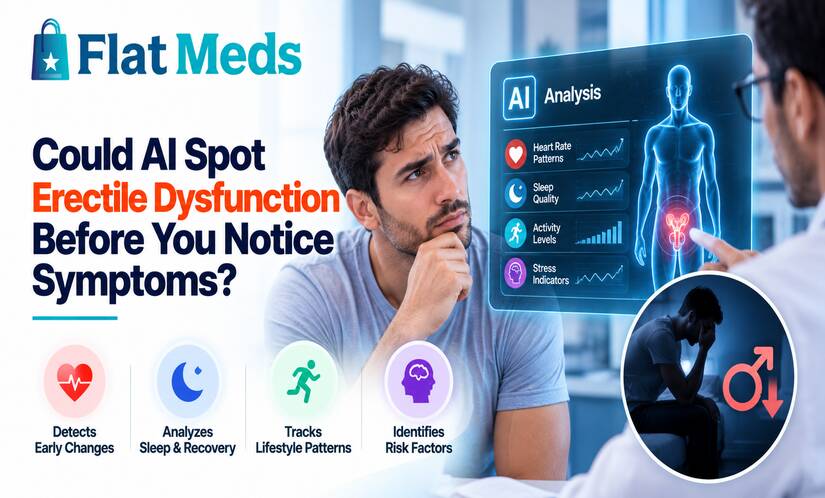
What if your health data could reveal a potential problem before you noticed the symptoms yourself?
Imagine an artificial intelligence system quietly analyzing patterns in your heart rate, sleep, physical activity, blood pressure, and other health information. Instead of waiting until erectile problems become persistent, could AI recognize subtle changes that may be associated with erectile dysfunction (ED)?
This is where the future of men’s health is becoming particularly interesting.
Can AI detect erectile dysfunction before symptoms become obvious? The answer is potentially—but not in the way many people imagine. Artificial intelligence cannot currently diagnose ED simply by analyzing a smartwatch or a single health metric. However, researchers are exploring whether machine learning, wearable technology, and digital biomarkers can identify patterns associated with erectile dysfunction and its underlying risk factors.
That distinction is important.
Erectile dysfunction can be influenced by cardiovascular health, blood flow, diabetes, obesity, medications, hormonal factors, sleep, stress, anxiety, and lifestyle. Some of these factors can be monitored or estimated through digital health technologies.
This raises an intriguing possibility: could AI spot a combination of subtle health signals that humans might overlook?
The technology is promising, but it is still developing.
Let’s explore how artificial intelligence could potentially identify early ED risk, what health data it may analyze, what smartwatches have to do with the process, and why AI should not replace professional medical evaluation.
Can AI Detect Erectile Dysfunction Before Symptoms Appear?
AI may eventually help identify patterns associated with erectile dysfunction before a person recognizes obvious symptoms, but it is not currently a standalone diagnostic tool for Erectile Dysfunction.
Artificial intelligence works by analyzing large amounts of information and identifying patterns that may be difficult to detect manually.
In healthcare, machine learning models can be trained using combinations of clinical, behavioral, physiological, and demographic information.
For erectile dysfunction, researchers are interested in whether AI can recognize patterns involving:
- Cardiovascular health
- Blood pressure
- Blood glucose
- Physical activity
- Sleep
- Heart rate
- Heart rate variability
- Body weight
- Medication use
- Lifestyle factors
- Patient-reported symptoms
The idea is not necessarily to create an algorithm that simply says “ED detected.”
Instead, a future AI system could potentially estimate whether a person’s overall health pattern is associated with a higher likelihood of erectile dysfunction and suggest that further evaluation may be appropriate.
That would make AI more of a risk-assessment or screening aid than a replacement for diagnosis.
How Could AI Identify Hidden Signs of ED?
The human body produces enormous amounts of health information every day.
Some of that information is obvious, such as blood pressure or blood glucose.
Other information is more subtle, such as changes in sleep patterns, resting heart rate, physical activity, or autonomic nervous-system activity.
AI can potentially analyze several variables at the same time.
For example, imagine someone has:
- Gradually declining physical activity
- Increasing sleep disruption
- Changes in resting heart rate
- Altered HRV
- Increasing cardiovascular risk
- Persistent but initially mild erection difficulties
A person might not connect all of these factors.
An AI system could potentially analyze them together.
This is known as pattern recognition.
The system does not necessarily need one measurement that proves ED. Instead, it looks for combinations of signals that may correlate with known health outcomes.
However, correlation is not the same as diagnosis.
An AI model can identify a statistical pattern without proving that erectile dysfunction is the cause.
What Health Data Could AI Analyze for ED?
AI-based health analysis could potentially use information from multiple sources.
These may include wearable devices, electronic health records, laboratory results, questionnaires, and patient-reported information.
| Data type | Example | Potential relevance |
|---|---|---|
| Cardiovascular | Heart rate, blood pressure | May provide information about cardiovascular risk |
| Wearable | HRV, activity, sleep | Can reveal long-term health and lifestyle patterns |
| Metabolic | Blood glucose, cholesterol | Relevant to several ED risk factors |
| Lifestyle | Exercise, smoking, alcohol | Can influence cardiovascular and sexual health |
| Patient-reported | Erection quality, symptoms | Provides direct information about sexual function |
The more diverse the data, the more opportunities AI has to identify relationships.
But more data does not automatically mean a better diagnosis.
The quality, accuracy, representativeness, and clinical validation of the data are extremely important.
Could Smartwatches Help AI Detect ED Risk?
Smartwatches are particularly interesting because they can collect health information continuously.
Instead of measuring a person’s heart rate once, a wearable can potentially record patterns across days, weeks, or months.
Depending on the device, available measurements may include:
- Resting heart rate
- Heart rate variability
- Physical activity
- Step count
- Sleep duration
- Estimated sleep stages
- Heart rhythm
- Other wellness measurements
AI could potentially analyze these data streams to identify patterns that correlate with health conditions.
For example, a future system might notice a combination of reduced activity, disrupted sleep, cardiovascular changes, and other validated signals.
That could potentially trigger a recommendation to discuss certain symptoms with a healthcare professional.
However, a smartwatch cannot currently diagnose ED simply because an AI system analyzes its data.
This distinction should remain clear.
Could HRV Be an Early Digital Biomarker for ED?
Heart rate variability, or HRV, has attracted considerable interest in digital health research.
HRV measures variations in the time intervals between heartbeats. It is influenced by the autonomic nervous system and can change with sleep, stress, exercise, illness, recovery, and other factors.
Researchers have explored whether HRV patterns may be associated with various health conditions, including cardiovascular and psychological factors.
Early research involving wearable-derived data has also investigated differences in HRV among men with and without erectile dysfunction.
This makes HRV an interesting candidate for future digital biomarker research.
But there is a major limitation:
HRV is not an ED test.
A low HRV reading does not mean a person has erectile dysfunction.
Likewise, a change in HRV does not establish that a person is developing ED.
AI may eventually become better at interpreting HRV alongside other information, but a single wearable measurement should never be treated as a medical diagnosis.
Can AI Use Sleep Data to Identify ED Risk?
Sleep is another potentially important part of the equation.
Sleep influences numerous aspects of health, including:
- Stress regulation
- Mood
- Energy
- Cardiovascular health
- Metabolic health
- Hormonal function
- Overall wellbeing
Sleep is also associated with normal nocturnal erections.
This means that changes in sleep may be relevant when evaluating sexual health.
Wearable devices can estimate sleep duration and patterns. AI could potentially analyze these measurements over time and identify unusual changes.
For example, an algorithm might recognize persistent sleep disruption rather than focusing on one poor night’s sleep.
That could be useful because chronic sleep problems may be associated with several health conditions that can also affect erectile function.
However, sleep data alone cannot diagnose ED.
A smartwatch can estimate sleep.
It does not directly measure penile rigidity or prove whether a nocturnal erection occurred.
Why Cardiovascular Health Matters in ED
One of the most important connections between AI, wearable technology, and erectile dysfunction is cardiovascular health.
An erection requires adequate blood flow and healthy vascular function.
Conditions that affect blood vessels may therefore also affect erectile function.
ED can occur alongside risk factors such as:
- High blood pressure
- Diabetes
- High cholesterol
- Obesity
- Smoking
- Physical inactivity
- Cardiovascular disease
This does not mean that every person with ED has cardiovascular disease.
It does mean that persistent erectile dysfunction can sometimes be an opportunity to examine broader health.
This is one reason AI-based risk assessment could eventually become valuable.
Instead of focusing exclusively on sexual symptoms, an AI system could potentially evaluate a person’s broader health profile.
Could AI Detect ED Through Blood-Flow Patterns?
Blood flow is central to erectile function.
During sexual stimulation, increased blood flow to the penis contributes to erection development and maintenance.
Problems affecting vascular function can therefore contribute to erectile dysfunction.
AI research in cardiovascular medicine has already demonstrated the potential of algorithms to identify patterns in complex health data.
In the future, researchers may investigate whether combinations of cardiovascular measurements can help identify people who are at increased risk of vascular ED.
However, a consumer wearable cannot currently measure penile blood flow directly.
A smartwatch may provide cardiovascular information, but it does not provide a complete vascular assessment of erectile function.
That requires appropriate clinical evaluation and, in selected cases, specialized testing.
What Are the Early Signs of Erectile Dysfunction?
If AI is eventually going to help identify ED risk, it still needs to be compared with the symptoms people actually experience.
Potential early signs of erectile dysfunction include:
- Erections becoming less firm
- Difficulty maintaining an erection
- Increasing difficulty achieving an erection
- Needing more stimulation than before
- Reduced consistency during sexual activity
- Fewer spontaneous erections
- Changes in morning erections
- Increasing anxiety around sexual performance
One isolated episode does not necessarily indicate erectile dysfunction.
Temporary erection difficulties can occur because of:
- Stress
- Fatigue
- Anxiety
- Alcohol
- Poor sleep
- Relationship problems
- Temporary illness
The more important issue is whether the problem becomes persistent or recurrent.
If erection difficulties continue, medical evaluation can help determine the underlying cause.
Could AI Recognize Symptoms You Have Not Connected Yet?
This is where artificial intelligence could potentially provide something humans sometimes struggle with: connecting multiple weak signals.
Consider a hypothetical example.
A person notices that their erections are not quite as firm as they were a year ago. They do not consider it serious.
At the same time:
- Their daily activity has decreased.
- Their sleep has become inconsistent.
- Their weight has increased.
- Their blood pressure is higher.
- Their resting heart rate has changed.
Individually, none of these necessarily means Impotence.
Together, however, they may represent a broader change in health.
An appropriately trained AI model could potentially recognize such combinations.
This is the concept behind predictive analytics.
But there is an important caveat: an AI model can identify risk patterns, not determine the personal cause without appropriate clinical assessment.
AI Detection vs. Traditional ED Diagnosis
| Approach | Main role | Key limitation |
|---|---|---|
| AI analysis | Identify patterns or estimate risk | Requires validation and quality data |
| Wearables | Collect continuous health information | Do not directly diagnose ED |
| Patient symptoms | Describe actual erectile difficulties | Subjective and variable |
| Clinical evaluation | Identify likely causes | Requires healthcare professional |
| Specialized testing | Assess specific physiological factors | Used only when appropriate |
This is why the future of AI in ED is more likely to involve assistance rather than replacement.
AI may help clinicians organize information, identify patterns, or prioritize potential risk—but diagnosis still requires clinical judgment.
Can AI Diagnose Erectile Dysfunction?
Not reliably as a standalone consumer tool.
Diagnosis of ED usually involves understanding the person’s symptoms, medical history, sexual history, medications, lifestyle, and existing health conditions.
A healthcare professional may also perform a physical examination and order appropriate laboratory tests.
Depending on the situation, assessment may consider:
- Blood pressure
- Blood glucose
- Cholesterol
- Testosterone
- Cardiovascular risk
- Medication effects
- Psychological factors
Validated questionnaires may also be used to assess erectile function.
In selected cases, specialized testing may be appropriate.
AI could potentially assist with some parts of this process in the future, but an algorithm should not be treated as a substitute for professional evaluation.
What Makes AI-Based ED Detection Difficult?
AI sounds powerful, but building a clinically reliable system is complicated.
1. ED has many causes
Erectile dysfunction can be:
- Vascular
- Hormonal
- Neurological
- Psychological
- Medication-related
- Lifestyle-related
- Or caused by multiple factors at once
An AI model needs to account for this complexity.
2. Health data varies between people
A heart-rate pattern that is normal for one person may be unusual for another.
Age, fitness level, medications, medical conditions, and lifestyle can all affect health metrics.
3. Wearable measurements are not perfect
Different devices use different sensors and algorithms.
Sleep estimates, HRV measurements, and other metrics can vary between devices.
4. Correlation does not prove causation
An AI model may discover that two variables occur together.
That does not necessarily mean one causes the other.
5. Privacy matters
Health data is highly sensitive.
AI-based healthcare systems need strong privacy, security, consent, and data-governance practices.
Why Digital Biomarkers Could Change Men’s Health
A digital biomarker is a measurable signal collected through a digital device that may provide information about a health condition or physiological state.
Digital biomarkers are particularly interesting because they can capture information continuously.
Traditional medical care often relies on occasional measurements.
A wearable, by comparison, may collect information throughout the day.
For ED research, digital biomarkers could potentially include:
- Heart-rate patterns
- HRV
- Activity levels
- Sleep characteristics
- Cardiovascular measurements
- Patient-reported symptoms
- Other validated physiological signals
AI could then analyze these measurements collectively.
This could eventually help researchers understand how changes in general health relate to changes in erectile function.
But digital biomarkers must be properly validated before they can be trusted in routine clinical care.
Can AI Predict ED Before You Notice Symptoms?
Potentially, but this remains an emerging research area rather than an established consumer-health capability.
Prediction is different from diagnosis.
Imagine an AI system determines that someone has a higher statistical likelihood of developing ED based on a combination of health factors.
That does not mean the person currently has ED.
It means the system has identified a pattern associated with increased risk.
A responsible system might then encourage the person to:
- Monitor symptoms
- Address lifestyle risk factors
- Discuss concerns with a healthcare professional
- Consider appropriate medical screening
That could make AI useful for early awareness without turning it into a self-diagnosis tool.
What Role Could Machine Learning Play?
Machine learning is a branch of artificial intelligence that allows algorithms to learn patterns from data.
In healthcare research, machine-learning models can be trained using large datasets.
For ED research, researchers could potentially provide models with combinations of:
- Clinical information
- Demographic information
- Cardiovascular measurements
- Laboratory results
- Lifestyle information
- Wearable data
- Patient-reported symptoms
The algorithm can then look for statistical relationships.
A successful model could potentially identify patterns associated with ED risk.
However, a model that performs well in one research dataset may not work equally well in the real world.
It needs external validation across different populations and healthcare settings.
Could AI Help Doctors Rather Than Replace Them?
This may be one of the most realistic applications.
Rather than replacing clinicians, AI could potentially act as an assistive technology.
For example, AI could eventually help:
- Organize patient data
- Identify unusual trends
- Summarize wearable information
- Highlight cardiovascular risk factors
- Identify patients who may benefit from further evaluation
- Support clinical decision-making
The doctor would still evaluate the patient, interpret the findings, consider symptoms, and make the final clinical decision.
This approach combines the strengths of both systems:
AI handles large amounts of data; clinicians provide medical context and judgment.
What Should You Do If You Notice Possible ED Symptoms?
Technology should not become a reason to delay medical care.
If you repeatedly have difficulty achieving or maintaining erections, consider discussing the issue with a healthcare professional.
This is particularly important if ED occurs alongside:
- Diabetes
- High blood pressure
- High cholesterol
- Obesity
- Smoking
- Cardiovascular disease
- Significant sleep problems
- Other new health symptoms
A medical evaluation can help determine whether the problem is related to vascular health, medications, hormones, psychological factors, lifestyle, or another cause.
Early evaluation may also provide an opportunity to address broader health risks.
How Can You Use Wearable Technology Responsibly?
If you use a smartwatch or fitness tracker, think of it as a health-awareness tool.
Focus on trends rather than individual readings.
Useful areas to monitor can include:
Physical activity
Look for changes in your normal activity level.
Sleep
Pay attention to persistent changes rather than one bad night.
Resting heart rate
Compare your readings with your own normal baseline.
HRV
Treat HRV as a general wellness metric rather than an ED test.
Overall health
Consider wearable data alongside your actual symptoms and lifestyle.
The goal is not to become obsessed with numbers.
The goal is to understand your health better.
What Could the Future of AI and ED Detection Look Like?
The future could involve a much more connected approach to men’s health.
Imagine a system that combines:
Wearable data + clinical information + laboratory results + patient symptoms + AI analysis
Instead of looking at one isolated measurement, the system could evaluate a person’s overall health profile.
For example, it might identify a combination of:
- Reduced activity
- Poor sleep
- Cardiovascular risk
- Metabolic changes
- Changes in reported erectile function
The system could then flag the pattern for further review.
This could potentially make healthcare more proactive.
Instead of waiting for a person to experience severe symptoms, technology could help identify people who may benefit from earlier conversations with healthcare professionals.
But this future depends on research.
AI systems need accurate training data, transparent validation, appropriate privacy protections, and evidence that they actually improve patient outcomes.
The Biggest Limitation: AI Is Only as Good as Its Data
One of the most important principles in artificial intelligence is simple:
Poor-quality data can produce poor-quality predictions.
If an AI system is trained on limited or unrepresentative data, its predictions may not work equally well for everyone.
This matters in men’s sexual health because ED can affect people with very different:
- Ages
- Medical conditions
- Lifestyle factors
- Medications
- Cardiovascular profiles
- Psychological backgrounds
An AI model therefore needs to be tested across diverse populations.
It also needs to distinguish between temporary erection difficulties and persistent erectile dysfunction.
Otherwise, it could generate unnecessary concern.
AI, Privacy and Men’s Sexual Health
There is another issue that should not be overlooked: privacy.
Sexual health information is highly personal.
An AI system analyzing wearable data, medical records, or sexual-health questionnaires could potentially handle sensitive information.
Responsible AI systems therefore need:
- Clear consent
- Secure data storage
- Appropriate access controls
- Transparent data practices
- Strong cybersecurity
- Clear explanations of how data is used
The benefits of AI should never come at the expense of basic privacy protections.
Frequently Asked Questions About AI and Erectile Dysfunction
1. Can AI detect erectile dysfunction before symptoms appear?
AI may eventually help identify patterns associated with ED risk, but it is not currently a standalone diagnostic method for detecting ED before symptoms appear.
2. Can artificial intelligence diagnose erectile dysfunction?
AI may assist with health assessment and pattern recognition, but a clinical evaluation is still needed to diagnose erectile dysfunction.
3. Can a smartwatch detect erectile dysfunction?
A smartwatch cannot directly diagnose ED, although its health data may eventually contribute to AI-based risk assessment.
4. Can HRV predict erectile dysfunction?
HRV may provide useful research data, but an abnormal HRV reading cannot independently predict or diagnose ED.
5. Can sleep data reveal ED risk?
Sleep data may provide information about health factors associated with ED, but sleep tracking alone cannot diagnose erectile dysfunction.
6. What health data can AI analyze for ED?
AI may analyze cardiovascular, metabolic, wearable, lifestyle, and patient-reported data to identify patterns associated with ED risk.
7. What are the early signs of erectile dysfunction?
Repeated difficulty achieving or maintaining erections, reduced firmness, and persistent changes in spontaneous erections can be potential early signs.
8. Is erectile dysfunction linked to heart health?
ED can be associated with cardiovascular and vascular risk factors, which is why persistent symptoms may warrant broader health evaluation.
9. Can AI replace a doctor for ED?
No, AI can potentially assist with data analysis, but professional medical assessment remains important for diagnosis and treatment decisions.
10. When should you see a doctor about ED?
Consider medical advice when erection problems are persistent, recurrent, worsening, or accompanied by other health or cardiovascular concerns.
Conclusion: AI Could Help Spot Patterns, but Symptoms Still Matter
So, could AI spot erectile dysfunction before you notice symptoms?
Possibly—but the technology is still evolving.
Artificial intelligence has the ability to analyze enormous amounts of information and identify patterns that may be difficult to recognize manually. When combined with wearable technology, AI could potentially examine heart rate, HRV, sleep, physical activity, cardiovascular measurements, lifestyle information, and patient-reported symptoms to identify patterns associated with erectile dysfunction.
That does not mean an AI system can currently look at your smartwatch and tell you that you have ED.
A prediction is not a diagnosis.
Erectile dysfunction can have many causes, including vascular, metabolic, hormonal, neurological, psychological, medication-related, and lifestyle factors. A reliable assessment therefore requires more than a single algorithm or health metric.
The most promising future may be one in which AI works alongside healthcare professionals rather than replacing them.
Wearable devices could continuously collect information. AI could help identify meaningful patterns. And clinicians could interpret those findings alongside symptoms, medical history, physical examination, and appropriate testing.
For now, the smartest approach is to use AI and wearable technology as tools for health awareness—not self-diagnosis.
If you notice persistent changes in erectile function, sleep, activity, cardiovascular health, or other aspects of your well-being, don’t wait for an algorithm to confirm that something is wrong.
Listen to your symptoms, pay attention to your health patterns, and speak with a qualified healthcare professional when concerns persist.
The future of ED detection may become more predictive, personalized, and technology-driven—but today, AI can provide clues, while clinical evaluation provides the diagnosis.