

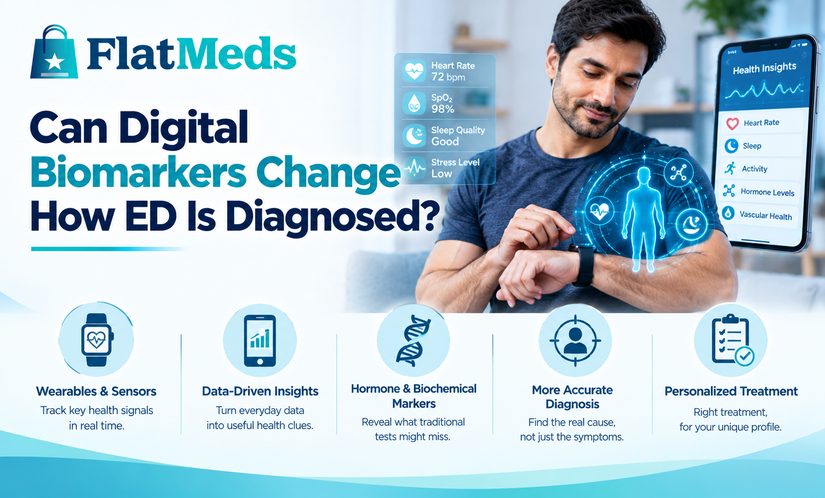
What if your body could reveal important clues about erectile dysfunction before you even step into a doctor’s office? From sleep patterns and physiological signals to wearable sensors and artificial intelligence, digital health technology is creating new possibilities for understanding men’s sexual health. These developments raise an important question: Can digital biomarkers change how Erectile Dysfunction is diagnosed?
Erectile dysfunction (ED) affects men’s physical health, emotional well-being, and relationships. Although doctors have established methods for diagnosing Erectile Dysfunction, identifying its underlying causes can sometimes require multiple assessments. Digital biomarkers may offer additional insights by collecting and analyzing measurable health data over time.
While this technology is promising, it is not yet a replacement for medical evaluation. Understanding how digital biomarkers work, what they can measure, and where their limitations lie is essential to assessing their potential role in modern urology.
What Are Digital Biomarkers?
Digital biomarkers are measurable physiological or behavioral indicators collected through digital technologies, such as wearable sensors, smartphones, connected medical devices, and health-monitoring applications.
Unlike a single measurement taken during a clinical appointment, some digital biomarkers can provide repeated measurements in everyday settings. Researchers can analyze these data to identify patterns associated with health conditions.
In erectile dysfunction diagnosis, potential areas of investigation include sleep-related erections, physical activity, sleep quality, and other physiological signals.
| Digital measurement | Potential application | Important limitation |
|---|---|---|
| Sleep patterns | Understanding sleep-related factors | Does not diagnose Impotence |
| Nocturnal penile tumescence | Measuring erections during sleep | Requires appropriate measurement technology |
| Heart rate variability | Studying associated physiological patterns | Not specific to Erectile Dysfunction |
| Physical activity | Assessing lifestyle-related factors | Cannot establish the cause of Erectile Dysfunction |
Digital biomarkers may complement traditional diagnostic methods, but their usefulness depends on measurement accuracy, clinical validation, and appropriate interpretation.
How Can Digital Biomarkers Change ED Diagnosis?
1. Monitoring Nocturnal Erections
- One promising area is nocturnal penile tumescence (NPT) monitoring. Healthy men commonly experience erections during sleep, particularly during rapid eye movement (REM) sleep.
- Measurements of nocturnal erection frequency, duration, and rigidity can provide information about erectile function. Clinicians may use this information as part of a broader evaluation when appropriate.
- Digital monitoring technologies could make it easier to collect repeated measurements in sleep-related settings. Research into wearable devices designed to measure penile tumescence and rigidity may help expand these capabilities.
- However, nocturnal erection measurements do not independently determine the cause of Erectile Dysfunction. Sleep disorders, medications, and other factors may influence results.
2. Using Wearable Devices to Collect Health Data
- Smartwatches, fitness trackers, and other wearable devices can collect information about sleep, movement, and heart rate.
- These measurements may help researchers explore relationships between general health and erectile function. For example, activity levels and sleep patterns can provide additional context when assessing cardiovascular health, obesity, or other conditions associated with Erectile Dysfunction.
- However, a smartwatch cannot currently be assumed to detect or diagnose erectile dysfunction independently. General wellness measurements are not equivalent to validated sexual health diagnostic tests.
3. Applying Artificial Intelligence to Digital Biomarkers
Artificial intelligence (AI) and machine learning can analyze large datasets to identify patterns that may be difficult to recognize through individual measurements.
In digital health research, these technologies may help investigate whether combinations of physiological signals, questionnaire responses, medical histories, and lifestyle information are associated with erectile dysfunction.
| AI application | Potential benefit | Current consideration |
|---|---|---|
| Pattern recognition | Identifies associations in health data | Associations do not prove causation |
| Risk assessment | Highlights factors for further evaluation | Requires clinical validation |
| Data analysis | Combines multiple measurements | Results depend on data quality |
| Patient monitoring | Summarizes changes over time | Clinicians must interpret findings |
AI-assisted digital biomarkers could eventually support clinical decision-making. However, a model’s ability to identify patterns does not automatically establish its diagnostic accuracy or clinical usefulness.
Digital Biomarkers vs. Traditional ED Diagnosis
Traditional ED assessment generally involves medical and sexual history, a physical examination when indicated, and selected laboratory tests. Doctors may evaluate diabetes, cardiovascular risk factors, hormonal health, medication use, and psychological contributors.
Digital biomarkers could add information to this process rather than replace it.
| Diagnostic approach | Main role | Key consideration |
|---|---|---|
| Medical history | Identifies symptoms and risk factors | Depends on accurate reporting |
| Physical examination | Assesses relevant clinical findings | Guided by clinical needs |
| Laboratory testing | Evaluates selected underlying conditions | Tests must be appropriately chosen |
| Digital biomarkers | Provides additional measurable data | Requires validated methods |
The International Index of Erectile Function and its five-item version, IIEF-5, are established questionnaires used to assess erectile function. Digital questionnaires may make it easier to collect patient-reported information, but they do not eliminate the need for appropriate clinical assessment.
What Are the Benefits of Digital Biomarkers for Erectile Dysfunction?
Digital biomarkers could offer several advantages if validated for specific clinical applications.
- More objective measurements: Direct physiological monitoring may provide information that complements a patient’s description of symptoms.
- Repeated monitoring: Some digital devices can collect measurements over multiple nights or across longer periods, potentially helping researchers understand variability.
- Personalized assessment: Combining validated measurements with medical history and clinical findings may help doctors develop a more complete picture of an individual’s health.
- Remote data collection: Appropriate digital tools could allow patients to collect certain measurements outside a hospital or clinic.
- Research opportunities: Larger datasets may help scientists investigate relationships between sleep, metabolic health, cardiovascular risk, and erectile function.
These potential benefits depend on the quality of the technology and evidence supporting its use. Not every digital measurement will be clinically meaningful.
What Are the Challenges and Limitations?
Despite their potential, digital biomarkers for erectile dysfunction face important challenges.
- Diagnostic accuracy: Researchers must establish how reliably each measurement identifies relevant clinical conditions.
- Lack of specificity: Sleep patterns and heart rate variability can be affected by many conditions unrelated to ED.
- Individual variation: Age, medication use, sleep quality, and existing health conditions can influence measurements.
- Privacy and security: Sexual health data require careful protection, informed consent, and appropriate data governance.
- Clinical validation: A promising prototype or research model may not perform well in routine healthcare settings.
Another concern is overdiagnosis. Interpreting normal variations in wearable data as evidence of erectile dysfunction could create unnecessary anxiety. Digital measurements should therefore be interpreted within an appropriate medical context.
What Does the Future Hold for Digital Biomarkers in Erectile Dysfunction Diagnosis?
The future of digital biomarkers in men’s health may involve combining direct physiological measurements with clinical history, validated questionnaires, laboratory results, and other relevant health information.
Researchers may investigate whether these combined approaches improve diagnostic accuracy, identify clinically important patterns, or help doctors monitor changes over time.
Before widespread clinical adoption, technologies will need to demonstrate reproducibility, safety, appropriate performance across patient populations, and meaningful benefits compared with established diagnostic methods.
The most realistic future is not one in which wearable devices replace doctors, but one in which validated digital tools provide additional information that supports more informed clinical decisions.
Frequently Asked Questions (FAQs)
1. Can digital biomarkers change how ED is diagnosed?
Yes, they may complement traditional assessment by providing additional physiological data, although their clinical role requires validation.
2. What are digital biomarkers for erectile dysfunction?
They are measurable physiological or behavioral indicators collected through digital technologies that may help researchers assess aspects of erectile function.
3. Can a smartwatch detect erectile dysfunction?
No smartwatch should currently be relied upon to diagnose ED independently.
4. What is nocturnal penile tumescence monitoring?
It measures erections during sleep and may provide useful information during selected clinical evaluations.
5. Can AI improve erectile dysfunction diagnosis?
AI may help analyze complex health data, but its diagnostic accuracy must be established through clinical research.
6. Are digital biomarkers better than traditional ED tests?
There is insufficient evidence to conclude that digital biomarkers are generally superior to established diagnostic methods.
7. Can sleep data reveal erectile dysfunction?
Sleep data may provide relevant context, but sleep measurements alone cannot establish an ED diagnosis.
8. Are digital biomarkers safe to use?
Their safety depends on the device, data handling practices, measurement method, and appropriate clinical interpretation.
9. Can digital biomarkers identify the cause of ED?
They may provide additional clues, but determining the underlying cause generally requires a comprehensive medical evaluation.
10. Will digital biomarkers replace doctors in the future?
Digital biomarkers are more likely to complement clinical expertise than replace doctors and established diagnostic assessments.
Conclusion
Can digital biomarkers change how Erectile Dysfunction is diagnosed? They have the potential to expand the information available to doctors by combining physiological measurements, wearable technology, sleep monitoring, and data analysis.
However, their effectiveness depends on reliable measurements, clinical validation, patient privacy, and integration with established medical practices. Wearables and AI tools should not be treated as standalone diagnostic solutions.
As research progresses, digital biomarkers may become useful additions to personalized erectile dysfunction assessment. For now, men experiencing persistent erectile difficulties should consult a qualified healthcare professional for an appropriate evaluation and evidence-based treatment options.