

You get into bed after a long day, scroll through your phone for “just 10 minutes,” watch a few videos, answer some messages, and finally put the screen away. You fall asleep later than expected—and the next morning, you feel tired and less energetic.
But could that nightly screen habit affect more than your sleep?
Can blue light before bed affect sexual performance?
The short answer is: possibly, but the relationship is more complicated than simply saying that blue light causes sexual problems.
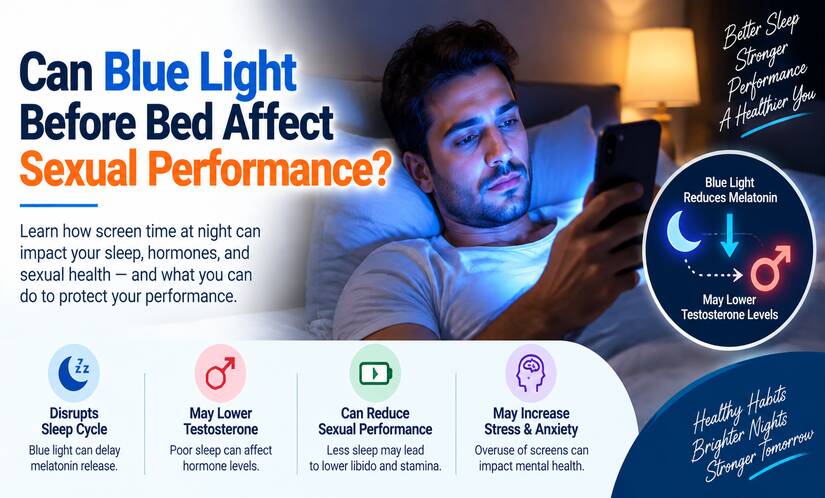
Research has established that evening exposure to light particularly short-wavelength blue light from smartphones, tablets, computers, televisions, and LED lighting can interfere with the body’s natural circadian rhythm and melatonin production. Poor sleep, sleep deprivation, stress, and disrupted circadian rhythms can, in turn, affect energy, mood, hormones, libido, and sexual function.
However, there is an important distinction: evidence directly proving that blue light itself causes erectile dysfunction or reduced sexual performance is limited. Much of the concern comes from the indirect pathway:
Blue light at night → disrupted sleep/circadian rhythm → poorer sleep and fatigue → possible effects on hormones, mood, libido, and sexual function.
This article explains what is known, what remains uncertain, and what you can realistically do about nighttime screen exposure.
What Is Blue Light?
Blue light is part of the visible light spectrum. It has a relatively short wavelength and comparatively high energy within visible light.
Natural daylight contains substantial amounts of blue light, and exposure during the daytime is important for maintaining a healthy circadian rhythm and alertness.
The concern is primarily exposure at night, when the body is preparing for sleep.
Common sources include:
- Smartphones and tablets
- Computer and laptop screens
- LED televisions
- LED and fluorescent lighting
- Other illuminated digital devices
Your eyes send information about environmental light to the brain’s circadian system. In the evening, exposure to light can delay the body’s transition toward sleep.
This is particularly relevant because sleep is not simply a period of inactivity. It is an active biological process involved in memory, metabolism, immune function, mood regulation, and hormonal processes.
Can Blue Light Before Bed Affect Sexual Performance?
The answer requires some nuance.
There is not strong evidence showing that ordinary blue-light exposure before bed directly causes sexual dysfunction. However, nighttime blue light can influence sleep and circadian timing, and those factors are relevant to sexual health.
Think of it as a chain rather than a single cause.
The potential pathway looks like this:
Nighttime blue-light exposure
↓
Melatonin and circadian rhythm effects
↓
Delayed sleep or poorer sleep quality
↓
Fatigue, stress and daytime sleepiness
↓
Potential changes in libido, mood and hormonal regulation
↓
Possible effects on sexual performance
This distinction matters.
If someone uses a phone before bed and experiences sexual-performance problems, it would be inaccurate to automatically conclude that blue light is the cause. Other factors—including stress, relationship issues, medications, alcohol, cardiovascular health, anxiety, depression, sleep disorders, and hormonal conditions—can play important roles.
How Does Blue Light Affect Sleep?
One of the strongest reasons scientists are interested in nighttime blue light is its relationship with the circadian system.
Melatonin is a hormone involved in regulating the sleep-wake cycle. Normally, melatonin levels rise in the evening as the body prepares for sleep.
Evening light exposure can suppress or delay melatonin signaling, depending on factors such as intensity, duration, timing, wavelength, and individual sensitivity.
This can potentially make it harder to fall asleep or shift the body’s internal clock later.
Why does this matter for sexual health?
Because sleep and sexual function are connected.
Consistently sleeping poorly can contribute to:
- Daytime fatigue
- Reduced energy
- Mood changes
- Increased stress
- Reduced sexual desire
- Difficulties with sexual arousal
- Changes in hormonal regulation
Therefore, the most scientifically reasonable connection between blue light and sexual performance is often indirect rather than direct.
Blue Light and Testosterone: Is There a Connection?
“Does blue light reduce testosterone?” is one of the most common questions surrounding this topic.
The answer is not straightforward.
Testosterone production follows biological rhythms and is influenced by several factors, including sleep, age, overall health, body composition, medications, stress, and other endocrine processes.
Some research has explored relationships between light exposure, circadian rhythms, sleep, and hormonal regulation. But that does not mean that using a smartphone at night automatically lowers testosterone to a clinically significant degree.
In other words:
Blue light → lower testosterone → sexual dysfunction
is not an established universal pathway.
A more cautious interpretation is:
Nighttime light exposure may disrupt sleep and circadian timing, while inadequate or disrupted sleep can influence hormonal regulation.
That is a very different claim from saying that every night of phone use directly reduces testosterone.
Factors that can affect testosterone more broadly include:
- Sleep duration and quality
- Age
- Obesity and metabolic health
- Chronic stress
- Certain medications
- Alcohol and substance use
- Physical activity
- Underlying medical conditions
So if you’re concerned about testosterone, focusing only on blue light may overlook much more important factors.
Blue Light, Sleep Quality, and Sexual Performance
Sleep may be the missing link when discussing blue light and sexual health.
A person who regularly stays awake late because of their phone may not simply be exposed to blue light. They may also be:
- Sleeping fewer hours
- Going to bed later
- Experiencing irregular sleep schedules
- Remaining mentally stimulated before bed
- Spending less time in restorative sleep
- Feeling tired the following day
This combination can be more important than blue light alone.
Can Poor Sleep Affect Sexual Performance?
Yes. Sleep quality and sexual health can influence each other in several ways.
Poor sleep can contribute to fatigue and reduced sexual desire. Sleep disorders can also be associated with sexual-function problems.
For men, erectile function is particularly complex because it depends on healthy blood vessels, nerves, hormones, psychological factors, and overall health.
For women, sexual desire and arousal can also be influenced by sleep, stress, mood, hormones, medications, and relationship factors.
Therefore, improving sleep can be a useful component of a broader approach to sexual health—but it should not be presented as a guaranteed treatment for sexual dysfunction.
Blue Light and Libido
Libido means sexual desire, and it can fluctuate considerably.
A person who is exhausted after several nights of inadequate sleep may naturally feel less interested in sex.
This doesn’t necessarily mean that blue light has directly reduced libido.
Instead, the relationship may involve several intermediate factors:
Late-night screen use → less sleep → fatigue/stress → reduced desire.
This is particularly relevant when screen use becomes habitual.
For example, someone who intends to sleep at 10:30 p.m. but scrolls until midnight may lose 90 minutes of sleep. If that happens repeatedly, the accumulated sleep deficit may affect daytime energy and overall well-being.
In that situation, the problem may be the overall nighttime behavior and sleep disruption, not simply the wavelength of light coming from the screen.
Does Blue Light Cause Erectile Dysfunction?
There is currently no simple scientific basis for saying that blue light directly causes erectile dysfunction.
Erectile dysfunction can have many causes, including:
- Cardiovascular and vascular conditions
- Diabetes
- Obesity
- Hormonal problems
- Certain medications
- Neurological conditions
- Smoking
- Alcohol and substance use
- Anxiety and psychological stress
- Relationship difficulties
- Sleep disorders
Sleep quality can also be relevant.
If someone experiences persistent erectile difficulties, blaming their phone or blue light alone could delay investigation of an underlying health issue.
Persistent or recurrent erectile dysfunction should be discussed with a qualified healthcare professional, particularly because it can sometimes occur alongside cardiovascular or metabolic health problems.
Does Using Your Phone Before Bed Affect Sexual Health?
Phone use before bed can affect sleep for reasons beyond blue light.
The content itself may keep the brain engaged.
For example, social media, work emails, gaming, emotionally stimulating conversations, and short-form videos can make it harder to mentally transition into sleep.
This means “screen time” and “blue light exposure” are related but not identical concepts.
A person could reduce blue-light exposure with a filter but still stay awake for another two hours watching videos.
A healthier nighttime routine may include:
- Setting a consistent bedtime
- Reducing bright light exposure in the evening
- Putting the phone away before sleeping
- Using warmer, dimmer lighting
- Avoiding stimulating content close to bedtime
- Keeping the bedroom dark and comfortable
The objective isn’t necessarily to eliminate every photon of blue light. It is to create conditions that support healthy sleep.
Blue Light and Women’s Sexual Health
The conversation around blue light and sexual performance often focuses on men, testosterone, and erectile function.
But sleep and circadian rhythms can also be relevant to women’s sexual health.
Female sexual desire and function are influenced by multiple biological, psychological, and social factors.
These can include:
- Sleep quality
- Stress
- Mood
- Hormonal changes
- Medications
- Relationship factors
- Physical health
- Pain or discomfort
- Life stage
There is not enough evidence to conclude that blue light directly causes female sexual dysfunction.
However, chronic sleep disruption and fatigue can potentially affect sexual desire and overall well-being.
So the practical recommendation is similar: prioritize good sleep and healthy nighttime habits rather than assuming that blue light is a standalone cause.
Blue Light Before Bed: What the Evidence Suggests
The following distinction can help separate established findings from claims that require more research.
| Topic | What is reasonably supported | What remains uncertain |
|---|---|---|
| Evening blue light | Can influence circadian timing and melatonin signaling | Individual effects vary considerably |
| Sleep | Evening light and device use can interfere with sleep timing/quality | Exact impact depends on intensity, duration and behavior |
| Testosterone | Sleep and circadian biology are relevant to hormonal regulation | Direct testosterone-lowering effect from normal screen exposure is not established |
| Libido | Fatigue and poor sleep can affect sexual desire | A direct blue-light-to-libido pathway is not established |
| Erectile function | Sleep and overall health can influence erectile function | Blue light itself has not been established as a direct cause of ED |
The key takeaway is that the strongest evidence concerns light, circadian rhythms, and sleep—not a direct causal relationship between blue light and sexual dysfunction.
How Long Before Bed Should You Avoid Blue Light?
There is no universally correct number of minutes that applies to everyone.
A practical approach is to reduce bright screen exposure during the period before bedtime and establish a consistent wind-down routine.
If you currently use your phone until the moment you fall asleep, you don’t need to make an extreme change overnight.
Try gradually creating a 30–60 minute screen-free or low-light period before bed and see whether it improves your sleep.
You can also experiment with:
- Lowering screen brightness
- Enabling night mode
- Using a blue-light filter
- Switching to warmer indoor lighting
- Keeping your phone away from your bed
- Reading a physical book instead of scrolling
- Avoiding work-related notifications at bedtime
The goal is better sleep—not achieving a perfect “zero blue light” environment.
Does Night Mode Actually Help?
Night mode and blue-light filters can reduce the amount of short-wavelength light emitted by a screen.
However, their effectiveness should not be overstated.
Changing the color temperature of a display does not automatically eliminate all effects of screen use. Brightness, duration of exposure, and psychological stimulation from the content can still matter.
So night mode can be one useful tool, but it should be part of a broader sleep strategy.
A simple nighttime setup could look like this:
- Reduce screen brightness.
- Turn on night mode.
- Use warm, dim room lighting.
- Stop demanding screen activities before bedtime.
- Keep your phone away from your pillow.
- Maintain a consistent sleep schedule.
Blue-Light Glasses: Are They Necessary?
Blue-light-blocking glasses have become popular because of concerns about nighttime screen exposure.
However, they should not be marketed as a guaranteed solution for sexual performance, testosterone, or erectile dysfunction.
If your primary problem is poor sleep, behavioral changes may be more useful than relying on a single product.
For example, putting the phone away earlier can simultaneously reduce:
light exposure + screen stimulation + delayed bedtime + lost sleep time.
That is a much broader intervention than simply wearing glasses while continuing to scroll for hours.
What Can You Do to Protect Sleep and Sexual Health?
If you’re concerned about the potential connection between nighttime screens and sexual performance, focus on the fundamentals.
1. Create a consistent sleep schedule
Going to bed and waking up at approximately the same time can help support your circadian rhythm.
2. Reduce evening screen exposure
Try establishing a screen-free period before bed.
3. Dim your environment
Bright room lighting can also contribute to nighttime light exposure.
4. Prioritize sufficient sleep
Don’t sacrifice sleep time simply to continue browsing, gaming, or watching videos.
5. Look at the bigger picture
Sexual performance is influenced by far more than blue light.
Pay attention to:
- Physical activity
- Stress
- Diet
- Alcohol consumption
- Smoking
- Cardiovascular health
- Medications
- Mental well-being
- Relationship factors
- Sleep disorders
6. Seek medical advice for persistent symptoms
If you regularly experience erectile difficulties, very low libido, pain, or other sexual-health concerns, don’t assume that your phone is responsible.
A healthcare professional can help identify potential causes and appropriate treatment.
Blue Light vs. Overall Screen Habits: What’s the Difference?
This distinction is often overlooked.
Imagine two people.
Person A uses a phone with a warm-color night mode for two hours in bed and sleeps six hours.
Person B uses a brighter screen for 20 minutes, puts the phone away, and sleeps eight hours.
It would be simplistic to conclude that Person A has eliminated the problem simply because their screen has less blue light.
Their overall behavior still involves:
- Longer screen exposure
- Later bedtime
- Potentially reduced sleep duration
- Cognitive stimulation
This illustrates why researchers and health professionals often consider sleep hygiene and overall nighttime behavior, rather than treating blue light as an isolated variable.
Can Better Sleep Improve Sexual Performance?
Better sleep can support overall physical and psychological health, and sleep quality is relevant to sexual health.
However, “better sleep improves sexual performance” should not be interpreted as a guaranteed cure for sexual dysfunction.
Sexual function has many interacting determinants.
If a person is chronically sleep deprived, improving sleep may address one potentially relevant factor. But persistent sexual problems may require assessment for other causes.
A healthy sleep routine can therefore be viewed as one part of comprehensive sexual-health care, not a replacement for medical evaluation.
The Bigger Picture: Sleep, Hormones, and Sexual Health
The human body does not operate through isolated systems.
The circadian rhythm interacts with sleep, metabolism, endocrine signaling, mood, and behavior.
That is why the question “Does blue light affect sexual performance?” cannot be answered simply with yes or no.
A more accurate framework is:
Light exposure affects circadian biology.
Circadian biology influences sleep timing.
Sleep influences energy, mood, and numerous physiological processes.
Those factors can influence sexual desire and function.
But there are many additional variables between these steps.
This is also why individual experiences can differ. One person may notice that late-night phone use leaves them tired and less interested in sex, while another may notice little difference.
Frequently Asked Questions
1. Can blue light before bed affect sexual performance?
Potentially indirectly. Blue light at night can interfere with circadian timing and sleep, while poor sleep can affect energy, mood, libido, and sexual function. Direct evidence that blue light itself causes sexual dysfunction is limited.
2. Does blue light reduce testosterone?
There is not enough evidence to conclude that ordinary nighttime smartphone or screen exposure directly causes a clinically meaningful testosterone reduction. Sleep and circadian disruption may be relevant to hormonal regulation.
3. Can blue light affect libido?
Possibly indirectly. If nighttime screen use contributes to insufficient or poor-quality sleep, fatigue and stress may reduce sexual desire. A direct blue-light effect on libido has not been firmly established.
4. Does using your phone before bed cause erectile dysfunction?
There is no established evidence that phone use or blue light directly causes erectile dysfunction. However, chronic sleep problems and other health factors can be associated with erectile difficulties.
5. How does blue light affect sleep?
Evening light exposure, particularly short-wavelength light, can affect circadian signaling and melatonin and may delay sleep timing or make it harder to transition into sleep.
6. How long before bed should you stop using screens?
There is no single scientifically guaranteed cutoff for everyone. A practical strategy is to reduce screen exposure during the 30–60 minutes before bed and use dimmer, warmer lighting.
7. Does night mode eliminate blue light?
No. Night mode generally changes the color characteristics of the display and can reduce short-wavelength emissions, but it does not eliminate all blue light or all effects of screen use.
8. Can poor sleep affect sexual performance?
Yes. Sleep quality and duration are relevant to physical and psychological health, and inadequate sleep can contribute to fatigue, stress, and changes in sexual desire or function.
9. Are blue-light glasses necessary for sexual health?
There is no basis for treating blue-light glasses as a necessary treatment for sexual-health problems. Improving overall nighttime habits and sleep may be more important.
10. When should I talk to a doctor about sexual-performance problems?
If sexual difficulties are persistent, recurrent, distressing, or accompanied by other symptoms, discussing them with a qualified healthcare professional is appropriate. Erectile dysfunction can have several underlying causes, including cardiovascular, metabolic, hormonal, psychological, and medication-related factors.
Final Takeaway
So, can blue light before bed affect sexual performance?
The most accurate answer is indirectly, potentially—but the evidence does not establish blue light itself as a direct cause of sexual dysfunction.
The stronger scientific connection is between evening light exposure, circadian rhythm, sleep, and overall health. If late-night phone or screen use delays your bedtime, reduces your sleep duration, or makes your sleep less restorative, those consequences may affect energy, mood, libido, and sexual function.
Rather than worrying about eliminating every source of blue light, focus on the bigger picture:
- Reduce bright screen exposure before bed.
- Consider a 30–60 minute wind-down period.
- Use dimmer and warmer lighting at night.
- Keep a consistent sleep schedule.
- Prioritize adequate sleep.
- Don’t assume blue light is the cause of persistent sexual problems.
- Seek professional medical advice when sexual difficulties continue.